 Kontakt
  Infocenter
  Log ind
 Det er påkrævet, at du allerede ejer Field of Glory II på Steam for at kunne bruge Field of Glory II: Wolves at the Gate.

 0 Indkøbskurv Indkøbskurv Indkøbskurv
 Ingen varer
Din kurv indeholder
0 Spil til en total pris af: 0,00 €
0 Spil til en total pris af: 0,00 €

Varen er nu lagt i din kurv
Antal
I alt
Der er 0 varer i din kurv Der er 1 vare i din kurv
Varer i alt
Forsendelse i alt Fastlægges senere
I alt
Field of Glory II: Wolves at the Gate (PC)
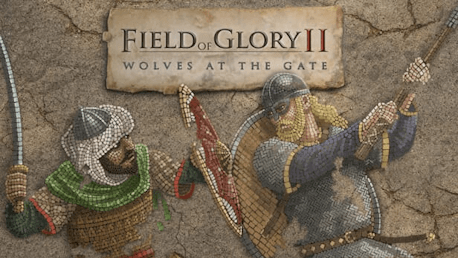
Field of Glory II: Wolves at the Gate (PC)

Field of Glory II: Wolves at the Gate skal aktiveres og downloades via Steam. Der vil ikke blive sendt et fysisk spil til din post-adresse. Steam .

BEMÆRK - DETTE ER EN UDVIDELSESPAKKE
FIELD OF GLORY II: WOLVES AT THE GATE SPILBESKRIVELSE
This expansion extends Field of Glory II forward to 1040 AD, exploring the rich military history of the so-called “Dark Ages”, from the whirlwind Arab Conquest to the depredations of the Vikings and Magyars, the birth of England, France, Germany and Spain, and the long struggle of the Byzantine Empire to keep Roman civilisation alive in the east.
From 600 to 628 AD the Byzantines were locked in a titanic struggle for survival against the aggressive Sassanid Persian Empire, from which they eventually emerged victorious. Both empires, however, were severely weakened. Six years later, in 634, the newly Islamized Arabs erupted forth from Arabia, quickly defeating the Byzantines and Persians. By 750, under the Umayyad Caliphate, the Muslim Arab Empire stretched from Spain to the borders of India.
The Byzantine Empire, after losing its Levantine and North African provinces, survived the initial Islamic advance. Constantinople endured a year long siege (717-718), and this proved to be the beginning of the end for the Umayyad Caliphate. Eventually, weakened by defeats on the frontiers of their vast empire and internal unrest, the Umayyads were overthrown by the Abbasid dynasty. The great Islamic Empire was now split into many separate, and often competing states. The Byzantines grew stronger under the Macedonian Dynasty (867-1056), and ended the period more powerful than they had been for many centuries.
In Northern Europe, Viking raids started in the late 8th century. Superb sailors, they used their longboats to strike across the Baltic and North Seas against towns, farms and monasteries, and raid as far as Seville and Constantinople. Eventually they settled down, and created important states in Normandy and the Kievan Rus. Their invasions of the British Isles resulted in centuries of intermittent warfare with the English, Irish and Scottish kingdoms.
Charlemagne ruled as King of the Franks from 768-814 AD. The kingdom he inherited already included most of modern France and parts of Germany. By his death in 814, his empire encompassed modern France, Belgium, the Netherlands, Germany, northern Italy and a strip of northern Spain. In 800 he was crowned “Emperor of the Romans” by Pope Leo III. After his death the Carolingian Empire split into two main states, West Francia (modern France) and East Francia (modern Germany).
In the 9th century the nomadic Magyars erupted into European history. Their western raids reached as far as Spain. Their defeat by the Germans at Lechfeld in 955 ended their threat to Western Europe and in 1000 their High Prince accepted Christianity and was recognised as King of Hungary by Pope Sylvester II, ruling under his Christian name of István (Stephen) I.
Summary of features:
- 19 new factions
- 55 new units
- 76 new army lists
- 6 new Epic Battles
- 74 new Quick Battles
- Expanded Custom Battles module.
- Expanded Sandbox Campaign module.
- 6 new historically-based campaigns.
- New Allies feature added in accompanying game update.
19 new named factions: Andalusians, Bulgars, Croatians, Dailami, Fatimids, French, Ghaznavids, Khazars, Khorasanians, Magyars, Moravians, Navarrese, Normans, Pechenegs, Polish, Rus, Scots, Serbians, Vikings.
55 new units: Huscarls (Spear), Huscarls (Axe), Mounted Huscarls, Berserkers, Well-Equipped Shieldwall (Offensive), Shieldwall (Offensive), Hirdsmen, Dismounted Hirdsmen, Picked Irish Foot (Axe), Irish Foot (Axe), Irish Kerns, (Dark Age) Armoured Lancers, Dismounted Armoured Lancers, (Dark Age) Lancers, Dismounted Lancers, (Dark Age) Armoured Cavalry (Light Spear), Dismounted Armoured Cavalry, (Dark Age) Cavalry (Light Spear), Dismounted Cavalry, Crossbowmen, Light Crossbowmen, Byzantine Kataphraktoi, Tagmatic Lancers & Archers, Thematic Lancers & Archers, Varangian Guard (Early), Byzantine Skutatoi, Byzantine Raw Skutatoi, Byzantine Massed Archers, Byzantine Light Archers, Byzantine Skutatoi & Archers, Raw Byzantine Skutatoi & Archers, Light Horse Archers (Pecheneg/Cuman), Horse Archers (Pecheneg/Cuman), Muslim Spearmen, Raw Muslim Spearmen, Veteran Muslim Spearmen, 'Abid al-shira, Muslim Irregular Foot, Armoured Muslim Lancers (Superior), Dismounted (Superior) Armoured Muslim Lancers, Armoured Muslim Lancers (Average), Dismounted (Average) Armoured Muslim Lancers, Muslim Lancers, Ghilman, Dismounted Ghilman, Muslim Cavalry (Light Spear), Muslim War Elephants, Muslim Light Horse (Javelins), Muslim Light Foot Archers, Muslim Light Javelinmen, Naffatun, Veteran Dailami Foot, Dailami Foot, Superior Indian Lancers, Indian Lancers.
76 new army lists (which expands the total number of army lists to 281):
- Alan 651-1049 AD
- Andalusian 756-1049 AD
- Anglo-Danish 1017-1041 AD
- Anglo-Saxon 600-870 AD
- Anglo-Saxon 871-949 AD
- Anglo-Saxon 950-1016 AD
- Arab (Conquest) 629-637 AD
- Arab (Conquest) 638-684 AD
- Arab (Umayyad) 685-750 AD
- Arab (Abbasid) 747-793 AD
- Arab (Abbasid) 794-814 AD
- Arab (Abbasid) 815-835 AD
- Arab (Abbasid) 836-873 AD
- Arab (Abbasid) 874-946 AD
- Arab (North Africa) 789-999 AD
- Arab (North Africa) 1000-1160 AD
- Arab (Syria/Iraq) 890-1008 AD
- Arab (Syria/Iraq) 1009-1150 AD
- Armenian 639-717 AD
- Armenian 885-1045 AD
- Avar 632-826 AD
- British 600-1030 AD
- Bulgar 631-679 AD
- Bulgar (Volga) 675-1237 AD
- Bulgar (Danube) 680-851 AD
- Bulgar (Danube) 852-1018 AD
- Byzantine 600-649 AD
- Byzantine 650-739 AD
- Byzantine 740-903 AD
- Byzantine 904-962 AD
- Byzantine 963-987 AD
- Byzantine 988-1041 AD
- Croatian 625-849 AD
- Croatian 850-1102 AD
- Dabuyid 642-760 AD
- Dailami 928-1055 AD
- Fatimid Egyptian 978-1073 AD
- Frankish 600-750 AD
- Frankish 751-887 AD
- French 888-1049 AD
- Georgian 1008-1049 AD
- German 888-932 AD
- German 933-1049 AD
- Ghaznavid 962-1187 AD
- Indian (Hindu North) 600-1049 AD
- Indian (Hindu South) 600-1049 AD
- Indian (Rajput) 650-1049 AD
- Irish 900-1049 AD
- Khazar 650-737 AD
- Khazar 738-969 AD
- Khorasanian 821-1003 AD
- Lombard 650-775 AD
- Lombard 776-1049 AD
- Magyar 830-1049 AD
- Moravian 833-907 AD
- Navarrese 778-899 AD
- Navarrese 900-1049 AD
- Norman 923-1040 AD
- Pecheneg 850-1122 AD
- Polish 966-1057 AD
- Rus 860-959 AD
- Rus 960-1053 AD
- Sassanid Persian 629-651 AD
- Saxon (Continental) 600-804 AD
- Scots 851-1051 AD
- Serbian 625-849 AD
- Serbian 850-1039 AD
- Spanish 718-899 AD
- Spanish 900-1049 AD
- Turkish 600-1036 AD
- Viking 790-899 AD
- Viking 900-1049 AD
- Viking (Ireland) 780-899 AD
- Viking (Ireland) 900-1049 AD
- Visigothic 622-717 AD
- Welsh 600-1049 AD
6 new Epic Battles: Yarmouk 636 AD (Byzantines vs Arabs), Ashdown 871 AD (Anglo-Saxons vs Vikings), Lechfeld 955 AD (East Franks vs Magyars), Apamea 998 AD (Byzantines vs Fatimid Egyptians), Chach 1001 AD (Indians vs Ghaznavids), Clontarf 1018 AD (Irish and Vikings vs Vikings and Irish) (each playable from either side).
74 new Quick Battles (each playable from either side).
Expanded Field of Glory II Custom Battles module now includes all 281 army lists from Immortal Fire, Rise of Rome, Legions Triumphant, Age of Belisarius, Rise of Persia and Wolves at the Gate. (Purchase of the appropriate DLCs is necessary to access them all).
Expanded Field of Glory II Sandbox Campaigns module now includes all 281 army lists from Immortal Fire, Rise of Rome, Legions Triumphant, Age of Belisarius, Rise of Persia and Wolves at the Gate. (Purchase of the appropriate DLCs is necessary to access them all).
6 new historically-based campaigns:
- Arab Conquest
- Basil II (Byzantine Resurgence)
- Charlemagne
- Mahmud of Ghazni
- Wolves from the Sea 1 (Viking Age from Viking point of view)
- Wolves from the Sea 2 (Viking Age from enemy point of view)
New Allies feature added in the accompanying game update allows you to include historical allies in either or both armies for SP and MP Custom Battles throughout the period covered by the game – now 680 BC-1040 AD. The game creates a composite army list drawn partly from the main army list and partly from the allied army list. This effectively increases the number of army lists to more than 700. (Purchase of the appropriate DLCs is necessary to access them all). Including “what if” battles, this increases the number of potential matchups to a mind-boggling 500,000 – before unit selection!
©2017 Slitherine Ltd. All Rights Reserved. Field of Glory II, Slitherine Ltd. and their Logos are all trademarks of Slitherine Ltd. All other marks and trademarks are the property of their respective owners. Developed by Byzantine Games.
OFTE STILLEDE SPØRGSMÅL
Hvordan virker det? Modtager jeg Field of Glory II: Wolves at the Gate fysisk?
Nej, du modtager en Field of Glory II: Wolves at the Gate produktnøgle (Field of Glory II: Wolves at the Gate CD Key), som du modtager via e-mail. Du skal derefter bruge Steam-platformen til at indløse din Field of Glory II: Wolves at the Gate produktnøgle (Field of Glory II: Wolves at the Gate CD Key), og du er derefter klar til downloade, installere og spille Field of Glory II: Wolves at the Gate. Ved køb af spillet, modtager du samtidig en vejledning til hvordan dette gøres, hvis du skulle være i tvivl. Så bliver det ikke nemmere!
This expansion extends Field of Glory II forward to 1040 AD, exploring the rich military history of the so-called “Dark Ages”, from the whirlwind Arab Conquest to the depredations of the Vikings and Magyars, the birth of England, France, Germany and Spain, and the long struggle of the Byzantine Empire to keep Roman civilisation alive in t
Genre Simulation Strategy Single-player Multi-player Shared/Split Screen Downloadable Content Steam Achievements Family Sharing
Publisher Slitherine Ltd.
Udvikler Byzantine Games
Platform PC
Udgivelsesdato 30-05-2019
Systemkrav MereDer er i øjeblikket ingen anmeldelser